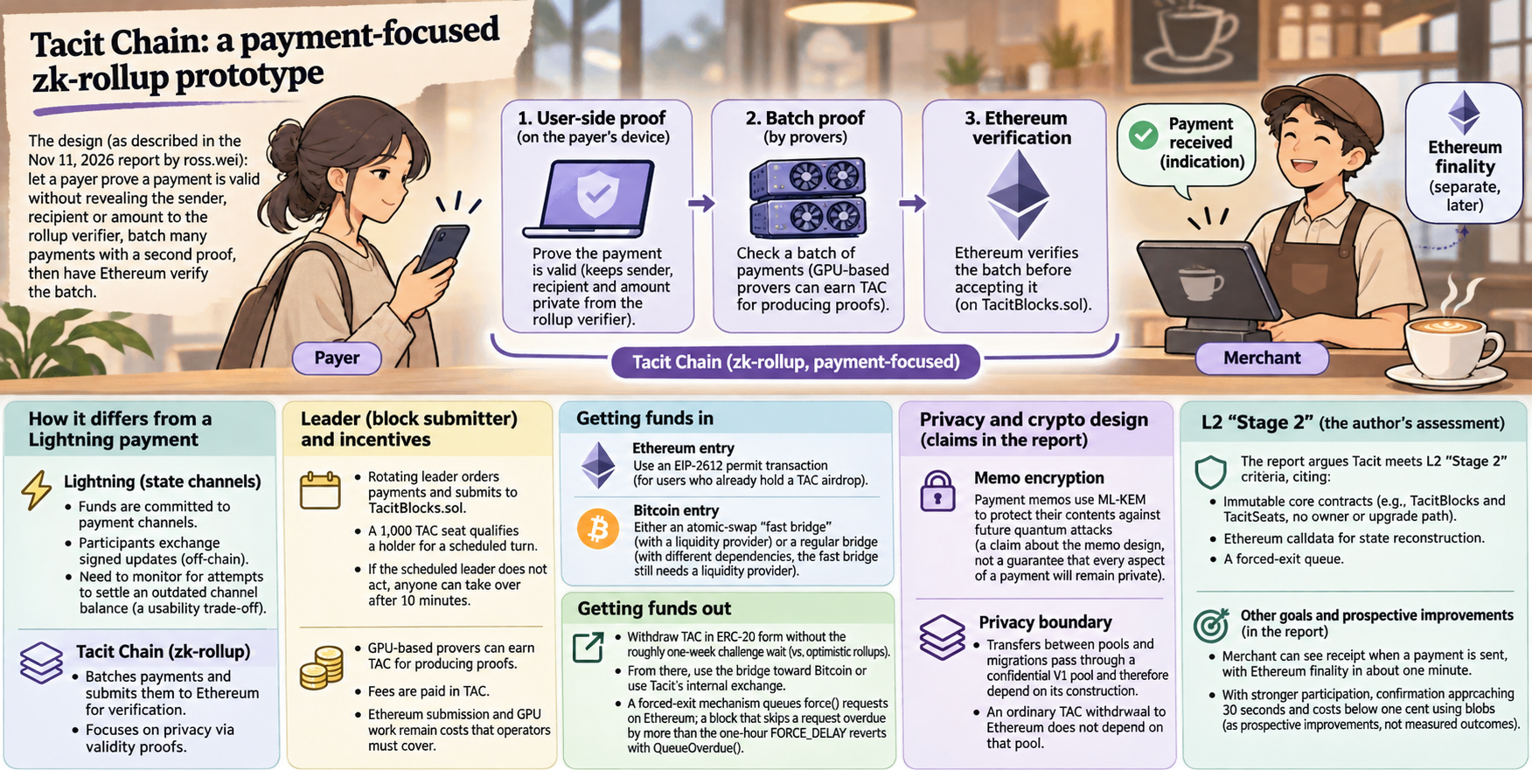
In a report published on November 11, 2026, author ross.wei described Tacit Chain as a payment-focused zk-rollup prototype. Its proposed journey is straightforward for the payer: prove a transfer is valid on the user’s device without revealing the sender, recipient or amount to the rollup verifier. A separate proof then checks the batch of payments before Ethereum accepts it. Those are design claims in the report, not an independent test of a shop’s checkout experience.

Where it differs from a Lightning payment
The author uses buying coffee to frame the need for quick merchant confirmation. Lightning takes a different route: funds are committed to payment channels, and participants exchange signed updates rather than putting each payment on-chain. The report notes the need to monitor for attempts to settle an outdated channel balance as a usability trade-off.

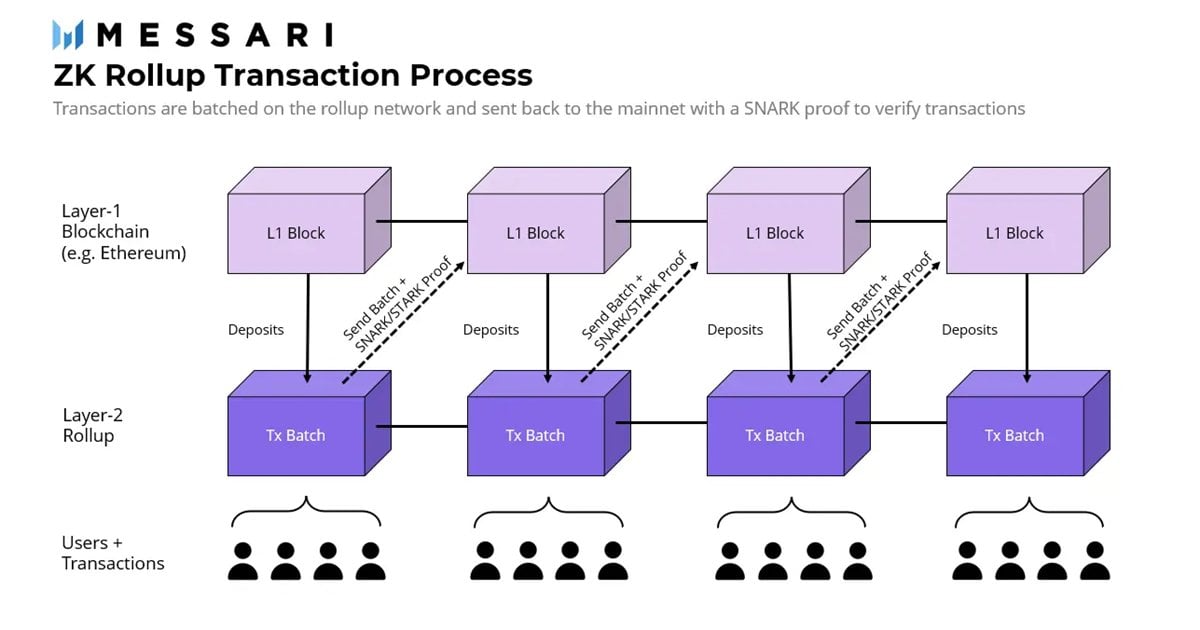
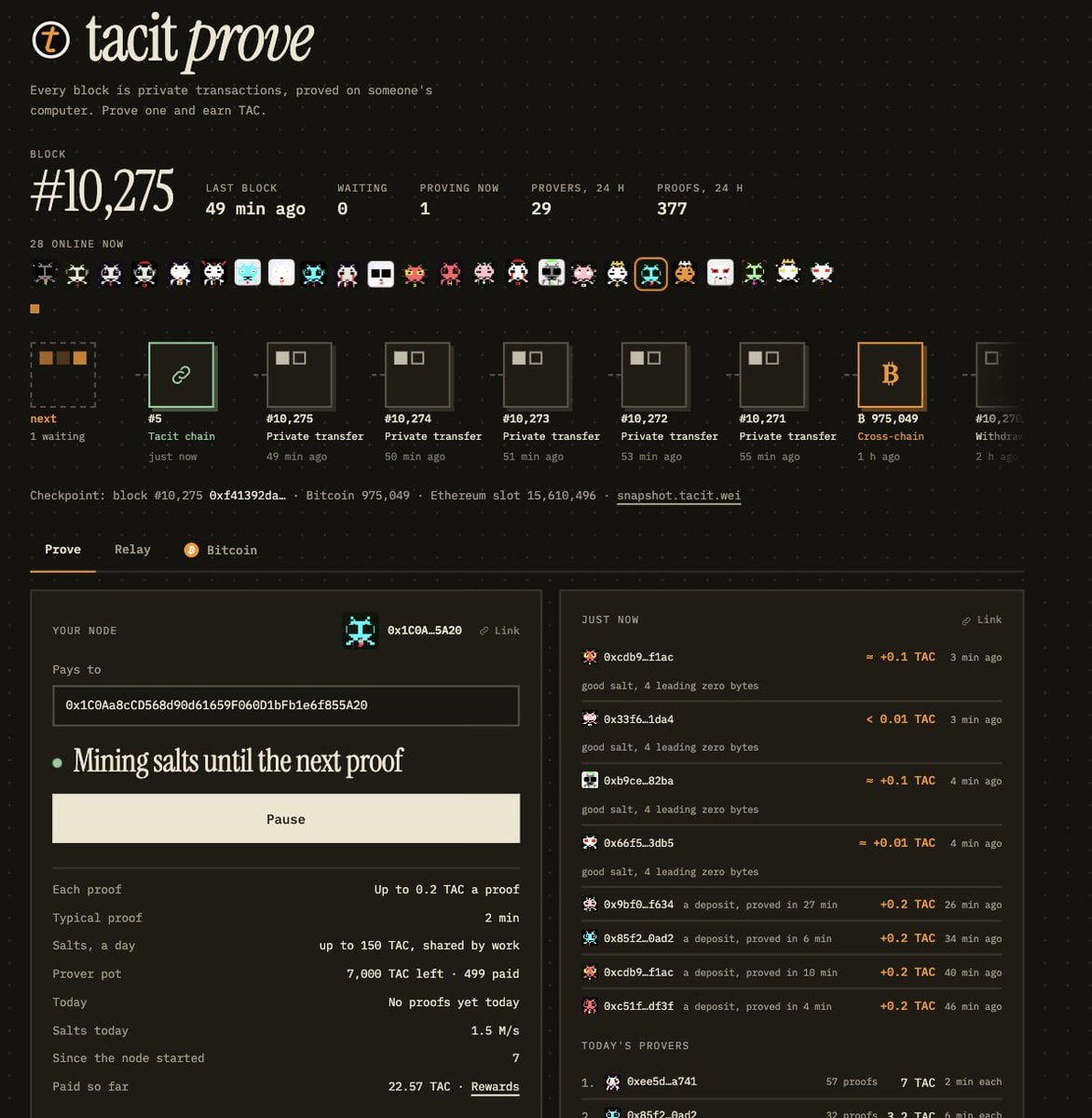
Tacit instead batches payments for Ethereum verification. Its rotating block submitter, called a leader, orders payments and submits them to the TacitBlocks.sol contract. According to the report, a 1,000 TAC seat qualifies a holder for a scheduled turn; if the scheduled leader does not act, anyone can take over after 10 minutes. GPU-based provers can earn TAC for producing proofs. Fees are paid in TAC, while Ethereum submission and GPU work remain costs that operators must cover.
Getting funds in—and getting them out
The report describes an Ethereum entry route using an EIP-2612 permit transaction for users who already hold a TAC airdrop, as well as Bitcoin entry through either an atomic-swap “fast bridge” with a liquidity provider or a regular bridge. Those routes have different dependencies; a fast bridge still needs a liquidity provider.
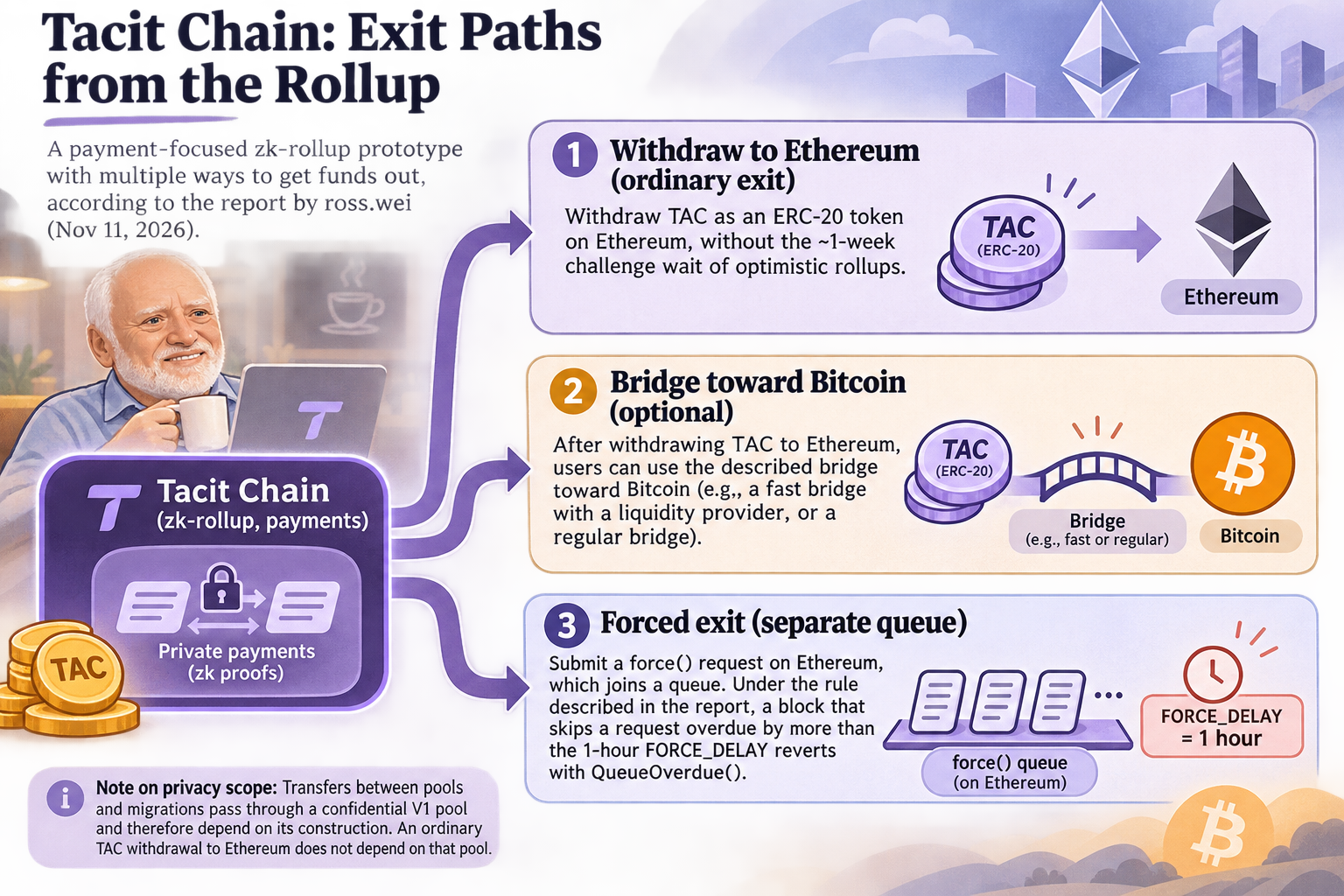
For exit, the author says users can withdraw TAC in ERC-20 form without the roughly one-week challenge wait associated with optimistic rollups. From there, they could use the described bridge toward Bitcoin or use Tacit’s internal exchange. A separate forced-exit mechanism queues force() requests on Ethereum. Under the rule described in the report, a block that skips a request overdue by more than the one-hour FORCE_DELAY reverts with QueueOverdue().
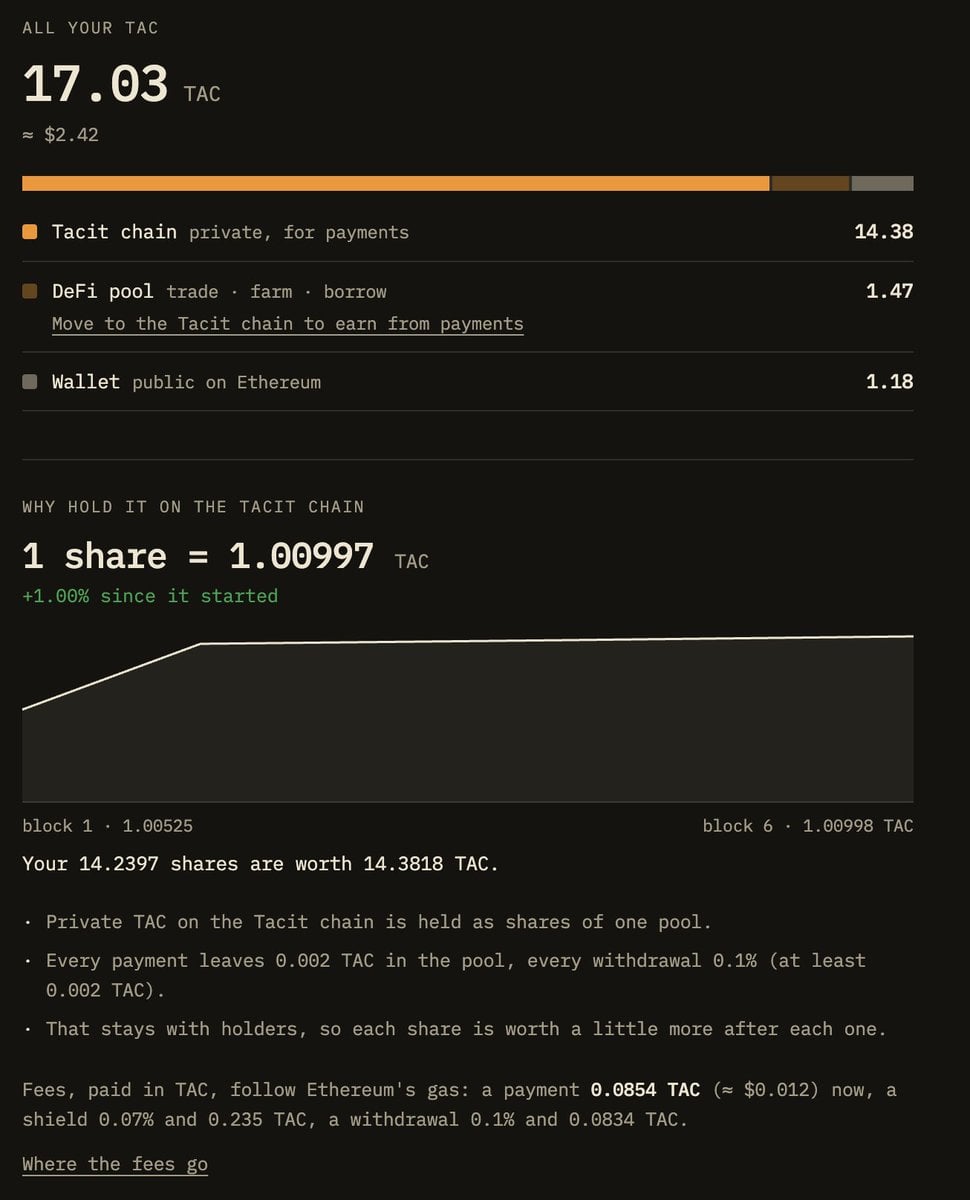
The privacy design also has a boundary: the report says transfers between pools and migrations pass through a confidential V1 pool and therefore depend on its construction. An ordinary TAC withdrawal to Ethereum does not depend on that pool.
What remains a claim or a goal
The author says merchants can see receipt when a payment is sent, with Ethereum finality in about one minute. The report presents confirmation approaching 30 seconds with stronger participation, and costs below one cent using blobs, as prospective improvements—not measured outcomes established here. It also says encrypted payment memos use ML-KEM to protect their contents against future quantum attacks; that is a claim about the memo design, not a guarantee that every aspect of a payment will remain private.
Finally, the author argues Tacit meets L2 “Stage 2” criteria, citing immutable core contracts, Ethereum calldata for state reconstruction and the forced-exit queue. That assessment is the author’s, rather than an independently established classification. The practical payment question remains how the described proof, bridge and exit paths work for a payer and a merchant outside the prototype’s design account.