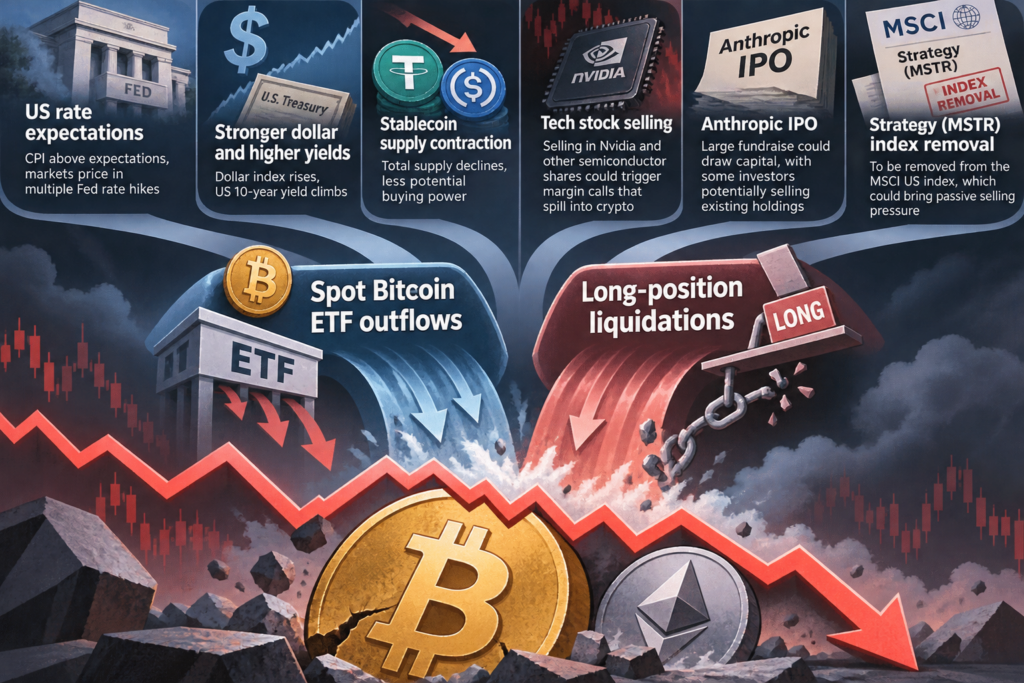
In a report published on November 15, 2026, BlockBeats said Bitcoin had briefly touched $62,000, citing HTX market data. Bitcoin was down more than 8% over 24 hours, while Ether had fallen more than 10%. The report said liquidations across the crypto market exceeded $2 billion over that period and affected more than 320,000 traders.
The report did not identify a single trigger. It pointed instead to ETF outflows, changing expectations for US interest rates and long-position liquidations that amplified the price decline.
ETF demand had weakened before the sell-off
As of November 13, US spot Bitcoin ETFs had recorded seven consecutive trading days of net outflows totaling about $1.91 billion, according to the report. Outflows for that week were $1.07 billion—the second straight week above $1 billion. US spot Ether ETFs saw about $399 million in net outflows that week, their seventh consecutive week of outflows.
The report said the Bitcoin ETF outflow streak began on November 5, before the US CPI release and Nvidia CEO Jensen Huang’s resignation. Its point was that buying through the ETF channel had already weakened before those developments.

Rate expectations and other possible pressures
US October CPI rose 0.4% from the previous month, while core CPI rose 0.3%; both readings exceeded market expectations. Citing the Financial Times, the report said that by Friday, November 13, interest-rate markets had fully priced in a 25-basis-point Federal Reserve increase in December and largely priced in another increase the following January. A week earlier, the implied probability of a January increase had been about 10%. Bank of America Global Research expected three 25-basis-point increases, in December, January and March—a total of 75 basis points.
The report also cited Federal Reserve Governor Christopher Waller as favoring a 25-basis-point December increase even if inflation improved. Waller said a monthly core CPI reading of about 0.3% or higher would warrant considering a 50-basis-point increase; the reported reading reached that threshold.
Other proposed explanations remained uncertain. BitMine chairman Tom Lee suggested that selling in Nvidia and other semiconductor shares could prompt margin calls that spilled into crypto holdings, particularly among Asian retail investors. He also cited a reported $6.3 billion theft of crypto assets from Binance as a possible factor, suggesting some holders might move into cash or stablecoins once affected funds became available again.
Lee further suggested that investors might sell existing holdings to fund participation in Anthropic’s proposed IPO and concurrent private placement. The report said Anthropic sought to raise up to about $90.4 billion and, citing Bloomberg, said orders were about six times the shares available. Lee’s suggestion that some Robinhood users might sell crypto if the platform received a large allocation was a possibility, not an observed flow.
Stablecoin supply and Strategy’s index removal
DefiLlama data cited in the report put dollar-stablecoin circulation at about $287.1 billion on November 15, down roughly $4.4 billion over seven days, $16 billion over 30 days and $25.8 billion from its May peak. Over 30 days, USDT supply fell about $8.1 billion and USDC about $3.6 billion. Circle’s figures showed USDC redemptions exceeding issuance by about $3.9 billion over the 30 days to November 12—evidence that funds were redeemed for dollars rather than merely moved between blockchains. Glassnode had separately reported a $14.2 billion contraction in stablecoin supply over the 30 days to November 9, the fastest since June 2022. The report treated shrinking supply as a sign of less potential buying power, not proof of a direct cause for the sell-off.
MSCI also confirmed that Strategy (MSTR) would leave its US index after the November review, effective after the US market close on November 30. Strategy had said funds tracking relevant MSCI indexes held about 13 million of its shares, or 3.1% of its basic shares outstanding; JPMorgan had previously estimated that removal could produce about $2.8 billion in passive selling. The index change does not require Strategy to sell Bitcoin. The report instead raised the possibility that sustained pressure on its share price could reduce its ability to raise money through share issuance for additional Bitcoin purchases.
Finally, the report noted that the dollar index closed at 103.41 on November 13, its highest level since April 2025, while the US 10-year Treasury yield closed at 5.154% after reaching 5.174% intraday. It presented a stronger dollar and higher yields as further pressure on assets that pay no interest.