
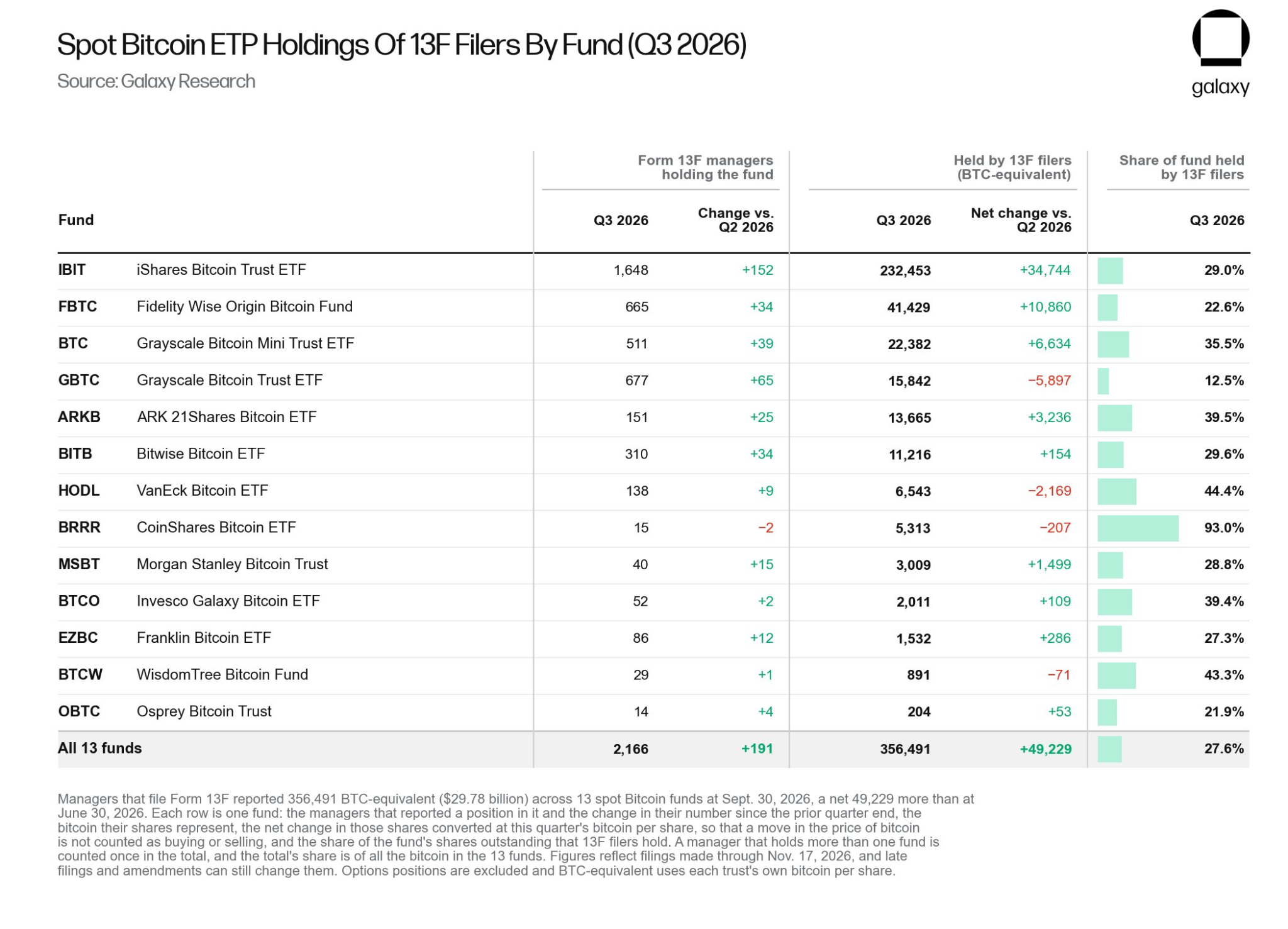
As reported on November 20, 2026, institutional investment managers’ reported holdings of US spot Bitcoin exchange-traded funds had reached a record high in the third quarter, reversing three consecutive quarters of net selling. Galaxy Research’s analysis of quarterly 13F filings found that reporting managers added shares equivalent to 49,229 Bitcoin (BTC), more than the 47,054 BTC equivalent they had shed over the preceding three quarters combined. Their reported holdings rose to a record 356,491 BTC equivalent.
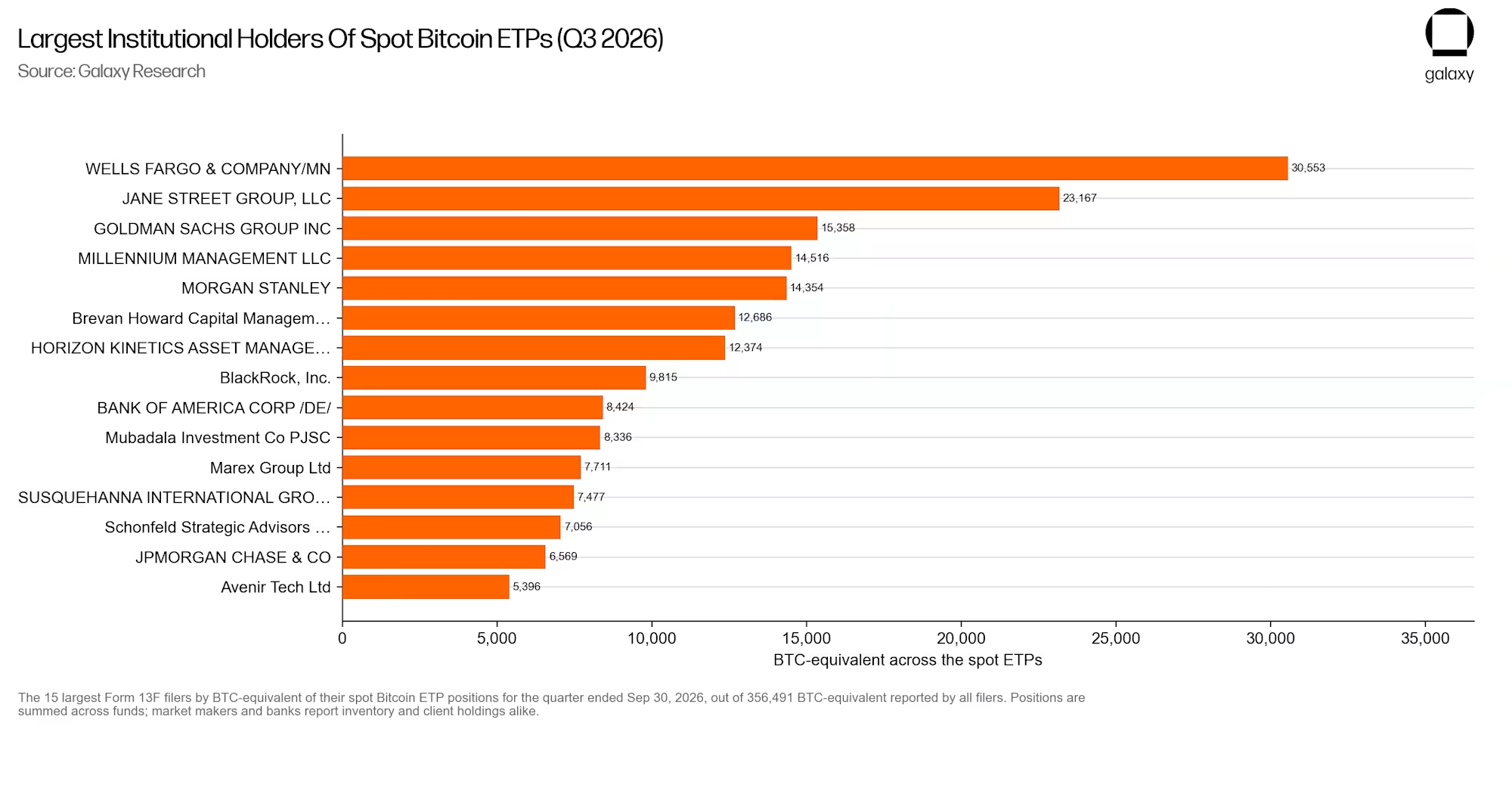
The increase was concentrated among a relatively small group. “The quarter’s accumulation was the work of a few dozen large institutions,” wrote Alex Thorn, Galaxy’s head of firmwide research. Thorn said advisors and wealth platforms accounted for half the net addition of spot Bitcoin ETF shares. Wells Fargo posted the largest increase—14,636 BTC equivalent—and became the largest institutional holder of spot Bitcoin exchange-traded products, according to the analysis. Brevan Howard, Bank of America, Millennium Management and Jane Street were also among the notable gainers.
The number of managers reporting a spot Bitcoin ETF position rose by 191 to 2,166, its first quarterly increase in three quarters. Bitcoin gained about 43% during the third quarter and ended September at $83,621. Galaxy found that BlackRock’s iShares Bitcoin Trust accounted for 232,453 BTC equivalent of the holdings reported by 13F filers; together with the Fidelity Wise Origin Bitcoin Fund, it accounted for 77% of their reported total.
The filings are a snapshot, not a live measure of demand. Quarterly 13F reports show US-listed securities held by reporting investment managers at a point in time. The record third-quarter positions therefore do not describe ETF flows after September. TFTC’s Bitcoin ETF tracker showed $515 million in net outflows in October and $2.9 billion in November outflows through the November 20 reporting date. Earlier that month, Bitwise head of research André Dragosch told Cointelegraph he viewed the selling as related to a short-term risk-off environment rather than a structural change in institutional sentiment.