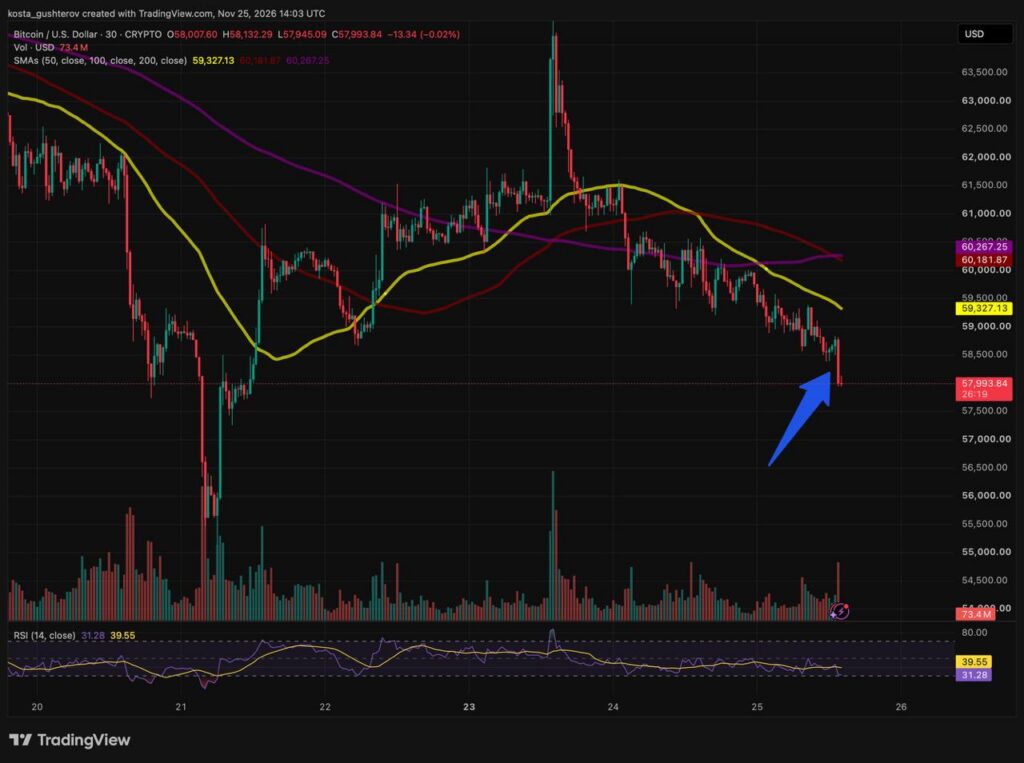
Bitcoin fell from about $58,800 to just above $58,000 in the half-hour after the US Bureau of Economic Analysis (BEA) released its October spending report at 8:30 a.m. ET on Nov. 25, 2026. It later touched $57,945. The report showed that US households had more income after inflation but spent slightly less, while the monthly pace of core inflation was unchanged.
The decline in bitcoin had begun before the release. After a weekend low of $55,130, the price briefly topped $63,500 on Nov. 23 before sliding again. Investors withdrew $569.7 million from spot bitcoin exchange-traded funds on Nov. 23 alone. The Nov. 25 move coincided with the economic report, but its timing does not establish that the figures prompted the selling.
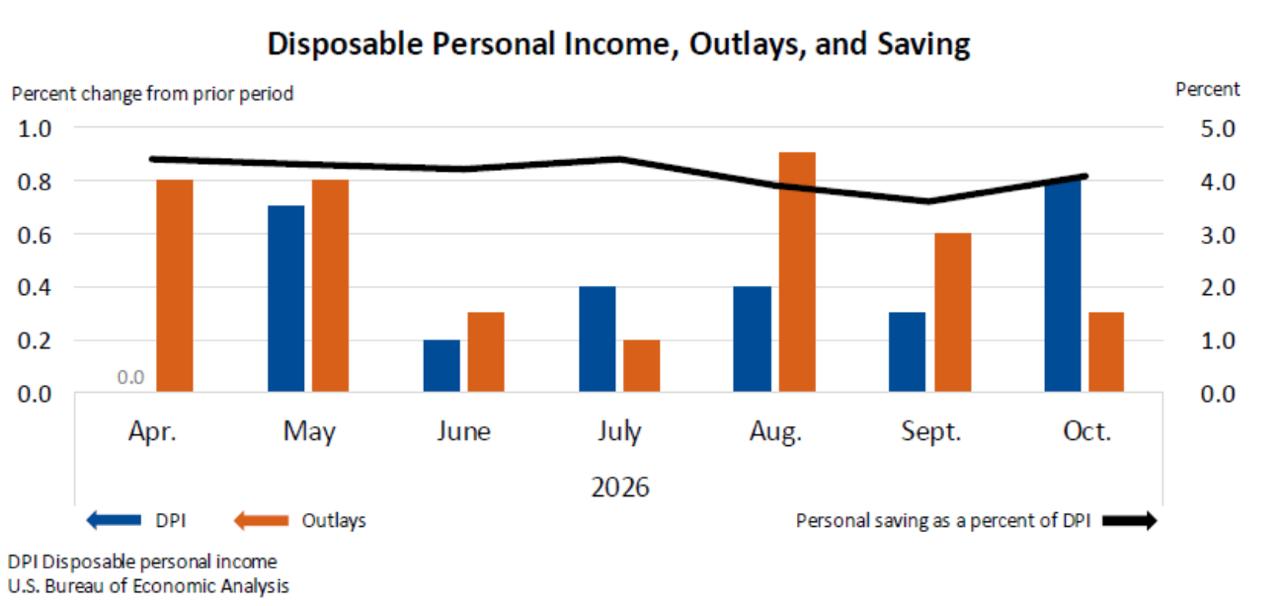
Income rose faster than spending
Personal income rose 0.7% in October, and disposable income — what households have left after taxes — rose 0.8%. Even after accounting for inflation, disposable income increased 0.5%, reversing a 0.2% decline in September. Compensation contributed the most to the increase, with dividends and government benefits also adding to income.
Consumer spending rose 0.3% in dollar terms but fell by $5.8 billion after inflation, a decline of less than 0.1%. The dollar change is expressed at a seasonally adjusted annual rate, not as cash spent in a single month. Households bought fewer goods: inflation-adjusted spending on goods fell 0.2%, while spending on services held up.
The personal saving rate rose to 4.1%, from a revised 3.6% in September. A one-time $90 Medicare Part B premium rebate went to about 20.8 million beneficiaries. By Coindoo’s calculation, the rebate accounted for roughly 0.1 percentage point of the 0.5-point rise in the saving rate. Most of the increase reflected households setting aside more of their regular income.

Why annual core inflation rose even as the monthly pace held steady
The personal consumption expenditures (PCE) price index rose 0.3% in October and 3.8% from a year earlier, both in line with forecasts. Core PCE, which excludes food and energy, rose 0.3% for the month, as it had in September. Its annual increase of 3.3% was the only one of the four readings to exceed forecasts: economists had expected 3.2%.
The annual comparison changed because October 2025, when core prices rose just 0.2%, dropped out of the 12-month calculation. The BEA had to estimate some prices for that month because a government shutdown interrupted data collection. Morningstar calculated that core prices rose an unrounded 0.29% in October 2026. If sustained for a year, that pace would amount to about 3.5%, above the Federal Reserve’s 2% inflation target.

The spending question ahead of the Fed meeting
Before the report, Bitwise noted that federal funds futures implied a 93% chance of a December rate increase. That was a market expectation, not a Fed decision. The Fed had raised rates in September for the first time since 2023, taking its target range to 3.75%–4.00%. It held rates there on Oct. 28 and said “domestic spending has been resilient.”
The latest figures give policymakers a reason to revisit that assessment. The BEA revised third-quarter economic growth up to a 4.3% annualized pace from 3.4%, but inflation-adjusted consumer spending rose just 0.1% in September before edging down in October. Two months of readings show spending cooled after the summer, not that a lasting decline has begun.
The Fed’s next rate decision and updated rate projections were scheduled for Dec. 9. With the BEA’s November income and spending report due Dec. 23, October’s figures were the last PCE reading scheduled before the vote.