
As reported on November 21, 2026, Tether had backed four companies between November 16 and 19 whose businesses touch cross-border dollar payments. The investments span customer-facing accounts, payment infrastructure and regulated service providers—but an investment does not, by itself, make USDT available to their customers.
Four investments, different roles
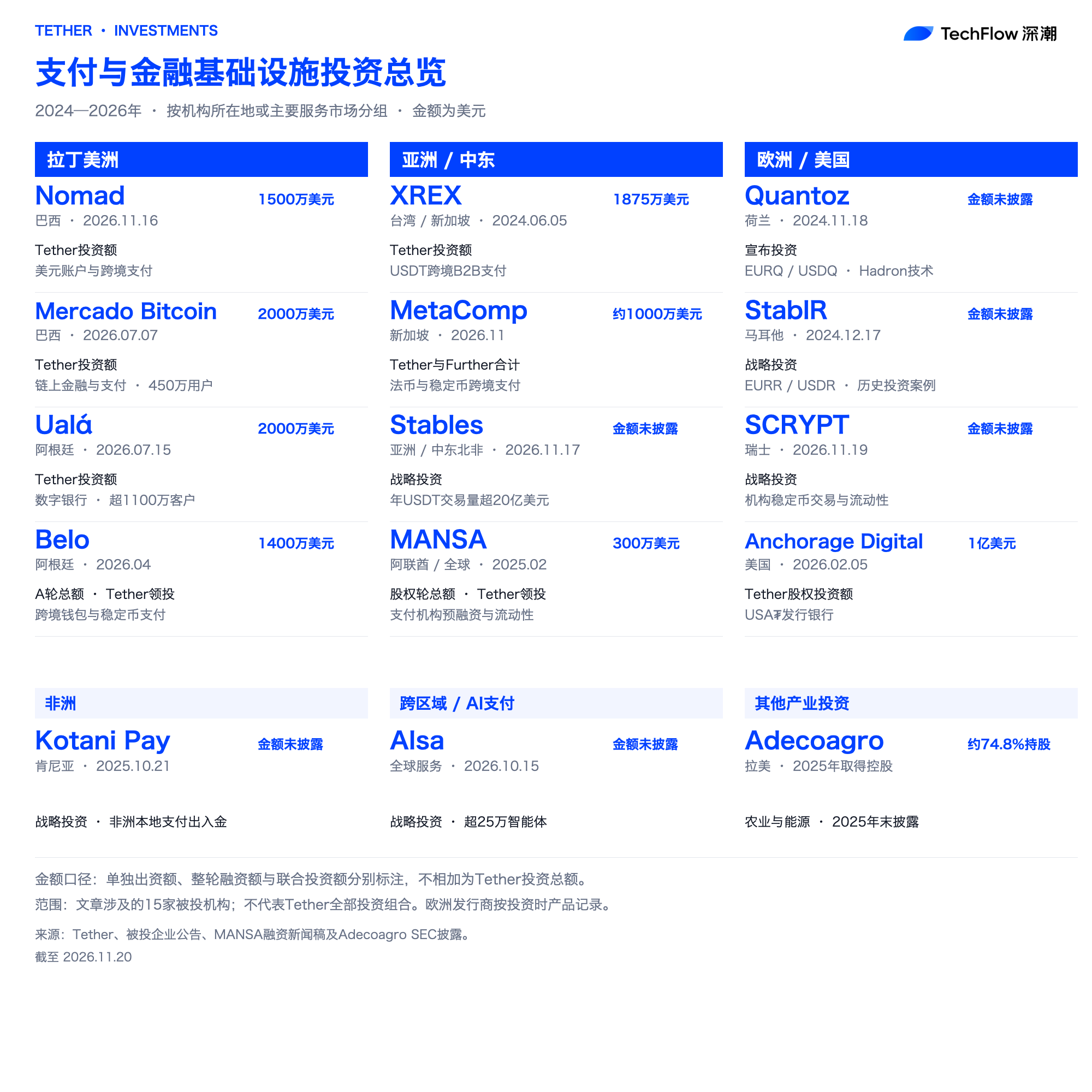
In Brazil, Tether Capital led a Series C round for dollar-account provider Nomad, contributing $15 million. The round totaled 172 million reais and valued Nomad at 4 billion reais after the investment. Nomad had 3.8 million customers and about 8 billion reais in assets under management. Integration of USDT and Tether’s gold token XAUT was still being explored, with no launch date announced.
Tether also invested in Stables, a payment-infrastructure company that processes more than $2 billion in USDT transactions annually and focuses on Asia and the Middle East and North Africa. In Singapore, Tether and Abu Dhabi-based Further Asset Management invested about $10 million combined in MetaComp, which holds a Major Payment Institution licence from the Monetary Authority of Singapore. The fourth investment was in SCRYPT, a Swiss stablecoin trading and liquidity provider operating under Swiss financial-market oversight.
For a customer sending money across borders, these companies could serve different parts of a payment route: an account they already use, infrastructure to move funds, or a regulated provider handling a local leg. The reported investments do not establish that all four offer a new USDT payment feature, or that a particular transfer route is available.
Liquidity and regulation remain constraints
An earlier investment shows the operational aim. In February 2025, Tether led a $3 million pre-seed round for MANSA, which provides USDT pre-funding liquidity to payment companies. That model is intended to reduce the funds those companies must hold in advance across locations; the report did not provide results for individual transfers.
Regulatory access is a separate limit. Despite Tether’s investment in Argentine digital bank Ualá, local restrictions meant USDT was not expected to be integrated in the near term. In Europe, USDT had not obtained EU authorization under MiCA, and licensed exchanges had restricted or delisted it. Buying a stake in a licensed business does not remove those constraints.
The investment push also comes against a financial backdrop. Tether reported $191.5 billion in reserve assets, including $132.4 billion in US Treasury exposure, as of September 30, 2026, and $4.5 billion in net operating profit for the first nine months of the year. The original report contrasted that with more than $10 billion in net profit for the comparable period a year earlier, while noting that net profit and net operating profit are different measures and cannot be directly subtracted. It said USDT issuance had remained around $184 billion during the first three quarters of 2026.