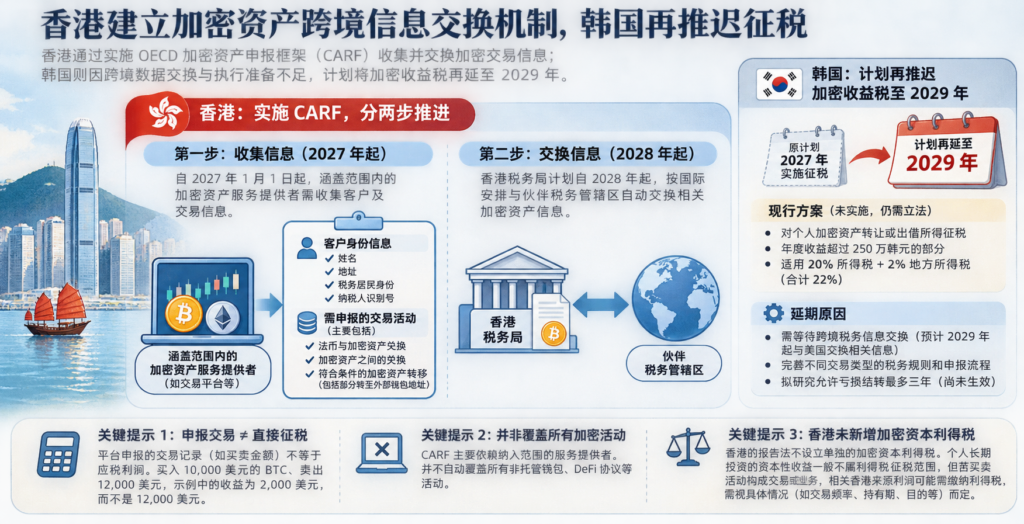
As reported on November 5, 2026, Hong Kong and South Korea were taking different steps toward taxing cross-border crypto activity. Hong Kong’s legislature passed a law to establish crypto-asset information reporting and exchange. South Korea’s government, meanwhile, said it planned to delay its crypto gains tax again, citing work still needed on enforcement and access to overseas transaction data.
What Hong Kong’s law changes
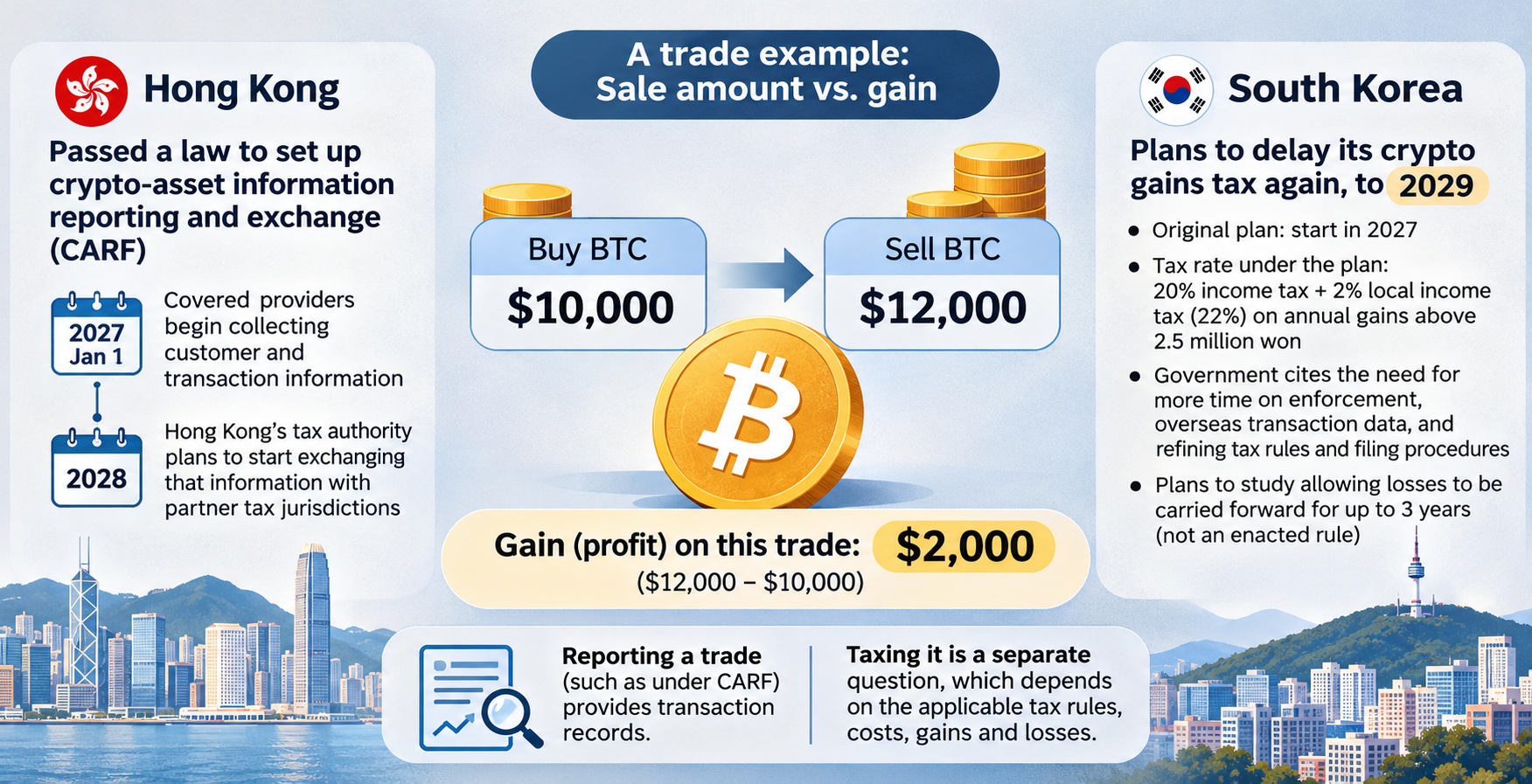
Hong Kong’s Legislative Council passed the legislation on November 4. Under its timetable, covered crypto-asset service providers must begin collecting customer and transaction information on January 1, 2027. Hong Kong’s tax authority plans to start exchanging that information with partner tax jurisdictions in 2028.
The law implements the OECD’s Crypto-Asset Reporting Framework, or CARF. Reportable activity principally includes exchanges between fiat currency and crypto, exchanges between crypto assets, and qualifying transfers—including some transfers to external wallet addresses. Covered providers must collect identifying details such as customers’ names, addresses, tax residency and taxpayer identification numbers.
Collection and exchange are separate steps: the 2027 start date does not mean every platform will send all customer records directly to foreign tax authorities that year. CARF also relies on providers within its scope; it should not be read as automatically covering every self-custodial wallet or DeFi transaction.
Why South Korea wants more time
South Korea had planned to begin taxing individuals’ income from transferring or lending crypto assets on January 1, 2027. Under the existing plan, annual gains above 2.5 million won would face 20% income tax plus 2% local income tax, for a combined 22% rate.
On November 5, South Korea’s finance minister said the government planned to postpone implementation by two years, to 2029. That would be the policy’s fourth delay, but the change still requires legislation. The government expects to begin exchanging crypto-related tax information with the United States in 2029. It warned that taxing domestic-platform activity before it can obtain comparable overseas records could make enforcement uneven. It also plans to refine tax rules and filing procedures.
The government said it would study allowing losses to be carried forward for up to three years. That is not an enacted rule. Under the earlier plan described in the report, relevant losses could be offset only within the same year.
Reporting a trade is not the same as taxing it
A transaction record, a sale amount and taxable profit are different things. Buying BTC for $10,000 and later selling it for $12,000 produces a $2,000 gain on that example trade—not $12,000 in profit. Trades across platforms, crypto-to-crypto exchanges and transfers to personal wallets can make the calculation more complicated. Whether an exchange such as ETH for USDT is taxable depends on the applicable jurisdiction’s rules, as do cost calculations and loss offsets.
Hong Kong’s reporting law does not create a separate crypto capital gains tax. Long-term personal investment gains of a capital nature generally fall outside its profits tax, while Hong Kong-sourced profits from activity amounting to a trade or business may be taxable. The distinction depends on the circumstances, including trading frequency, holding period and purpose.
Cross-border reporting may give tax authorities a clearer view of some trades. It does not make every visible transaction taxable, nor does using an overseas exchange change a person’s tax residency by itself.