A stablecoin cardholder buying groceries in local currency can earn cashback on the purchase and still lose most of that reward to an exchange fee. In a November 25, 2026 analysis, DWF Ventures said most crypto card spending settles in US dollars. For customers spending in another currency, the conversion fee runs from 0.5% to 2% and can absorb nearly all the cashback.
DWF sees a bigger opportunity for card providers in two services that remain scarce: settling purchases in more than one currency and letting customers move money between a stablecoin balance and the local accounts they already use.
A dollar balance is easier to offer than a local payout
DWF uses crypto neobank to mean a company whose main business is issuing crypto payment cards. Unlike earlier mobile banking services such as Revolut and Nubank, which use traditional settlement networks, stablecoin-based providers can use infrastructure from companies such as Bridge and Rain to reach dozens of markets at launch. Some also offer self-custody and access to on-chain yield.
That reach matters to people earning money across borders, small businesses and residents with limited access to dollars. But receiving stablecoins, paying a merchant and withdrawing local currency are distinct tasks. A card may cover the purchase without giving its holder a convenient way to convert the remaining balance and send it to a local account. DWF argues that these local connections are difficult for competitors to replicate.
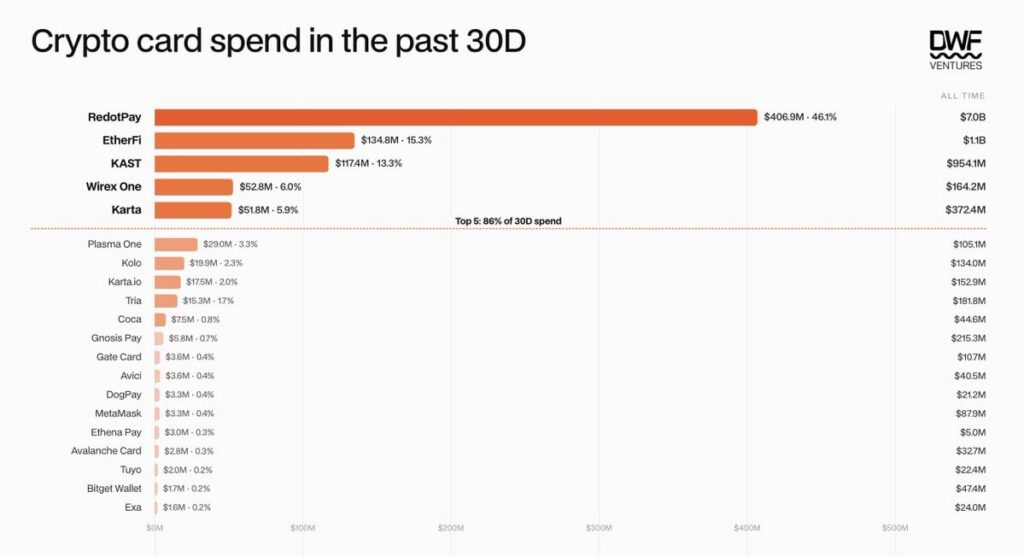
The market is growing but remains concentrated. PaymentScan figures cited by DWF showed that weekly crypto card spending had risen nearly 200% year over year. The five largest programs accounted for more than 86% of spending, with RedotPay alone handling more than 46% of volume.
DWF presents RedotPay as an example of competing on access rather than rewards. It holds licenses in Hong Kong, the United States, Canada and Argentina and supports multiple payment methods. In DWF’s assessment, its reach has helped it retain market share despite relatively high card fees because it offers an accessible, cheaper alternative to traditional remittances in parts of Africa and Latin America.
What customers spend and what providers keep
For every dollar customers loaded, they spent an average of $0.65 to $0.75. DWF said customers at EtherFi and KAST spent a smaller share of their deposits; both programs offered annual percentage yields of 7% to 9% on dollar stablecoin deposits at the time of the analysis. DWF interpreted the difference as a sign that customers valued the apps as places to hold funds as well as spend them.
Card programs earn fees on purchases, currency and crypto conversions, and transfers into and out of the service. Cashback sends some of that revenue back to customers. DWF reported that most programs retained less than 1% of card spending after cashback, while subsidies could reach 2% to 3% per dollar spent. Reward caps limit the cost of attracting a customer, but DWF said profitability remained uncertain.
The business beyond the card
One option for a provider is to issue its own stablecoin and earn income on idle balances that would otherwise accrue to an issuer such as Circle or Tether. KAST uses M0 to issue its stablecoin, while EtherFi uses Ethena. DWF estimated that at an assumed 4% yield, EtherFi users’ balances could generate about $2 million a year. That was a revenue estimate, not reported earnings or a promised customer return.
Other providers are adding credit or trading. Customers can borrow against assets held in an app through a third-party lending protocol rather than borrowing from the card provider’s balance sheet. DWF said ether.fi Cash operated its credit service on Aave V4, with more than $47 million in loans. Phantom, meanwhile, added perpetual-contract trading through Hyperliquid alongside its payment card, bringing spending and trading into the same wallet.
DWF argues that winning savings balances depends on trust built through licensing, regulatory protections and a track record customers can verify. It also distinguishes a sustainable source of yield from a promotional reward: Ethena Pay, for example, draws yield from Ethena’s own strategies, while deposits increase demand for USDe. For someone paid in stablecoins but paying bills in local currency, however, neither yield nor cashback solves the final step. The practical question is whether the app can move the money into the account they need, and what the conversion costs.