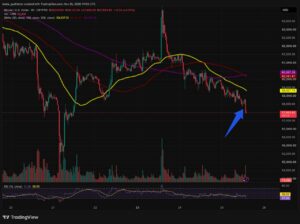
Bitcoin was struggling to hold $60,000 on November 25, 2026, after trading as low as $55,300 on November 21. That drop took it below the June low of $58,500 and the low set in July. Bitcoin was trading at roughly half its all-time high.
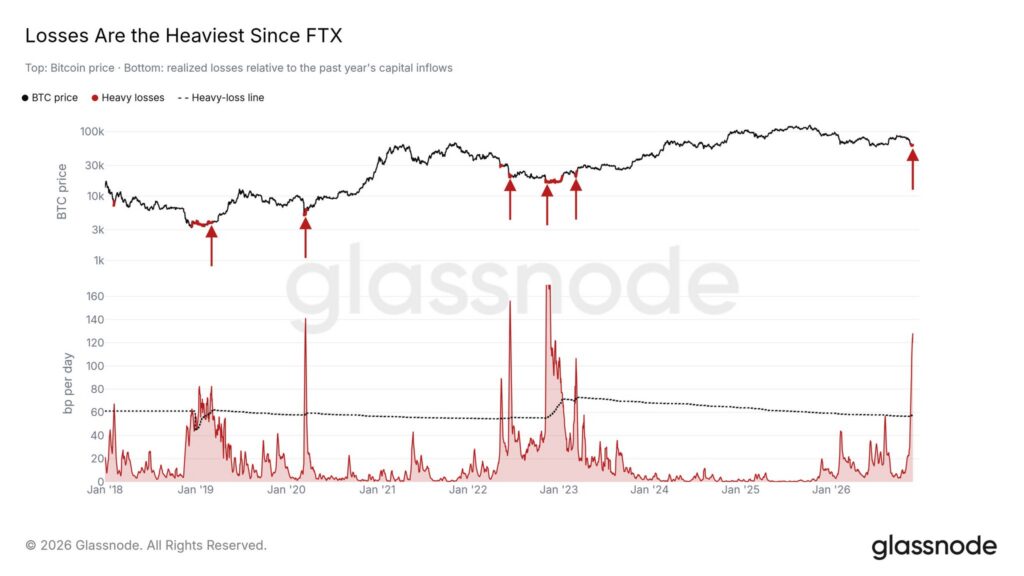
Glassnode reported on November 24 that realized losses, measured against the capital that had flowed into Bitcoin over the previous year, had nearly doubled in a week. On that measure, losses were the heaviest since the FTX collapse in November 2022. Glassnode cautioned that while similar spikes had often occurred near market lows, some had come before prices reached a bottom.
What the loss figures show
From mid-April to mid-November, most realized losses came from long-term holders, defined here as investors who had held their coins for about five months or more. Bitcoin had not, however, closed below its realized price: the average price at which each coin last moved. That benchmark stood at $53,200, a little more than 10% below the November 25 trading level.
The distinction between a trading low and a closing price matters here. Bitcoin closed below the $62,000–$66,000 range on November 19, turning a former area of support into resistance. The sell-off’s lowest close came on November 20, just above June’s lowest close, even though Bitcoin traded below its summer lows the next day.
US demand weakens as Bitcoin trails the Nasdaq
US spot Bitcoin exchange-traded funds recorded $4.3 billion in net outflows over 20 trading days, one of their largest such outflows since launch. Over 30 days, traders taking available prices on Coinbase, a major venue for US investors, were heavy net sellers. Comparable buying and selling on Binance were roughly balanced.
Bitcoin’s correlation with the Nasdaq 100 was at its highest since September 2022, but the two had not moved equally. Over 60 trading days, Bitcoin gained less when the index rose and lost more when it fell. On November 23, after Nvidia brought Jensen Huang back as CEO, Bitcoin rose 5% in about half an hour. It gave up the entire gain in less than six hours, while the Nasdaq 100 still held about three-quarters of its advance. By November 24, stocks had also surrendered most of that gain.
Leveraged positions thin out
Nearly 90% of the leveraged long positions that had stood between Bitcoin’s market price and its realized price a week earlier were gone. A cluster of longs remained near $51,500, below the realized price. Most remaining potential liquidations were short positions above the market, with the largest cluster near $87,500.
Options trading also leaned bearish. The previous week’s seven-day average reached 1.7 puts for every call, the highest ratio since June 2022. Dealer positioning varied by price: between $58,000 and $64,000, dealers were short gamma, meaning their hedging could amplify moves in either direction. In the neighboring $56,000–$58,000 and $64,000–$66,000 ranges, they were long gamma, where hedging tends instead to dampen moves.